Making Your Technical Docs AI-Ready?


Improving Engineering AI Accuracy from 75% to 95%+ with Visual Retrieval



Case Study Summary
Executive summary
An engineering documentation company used Google Vertex AI RAG Engine to power a chatbot that answered questions from technical manuals and software guides. However, its text-based retrieval could not show the CAD screenshots, connection diagrams and dimension drawings that engineers needed to understand the answers.
WhizzBridge redesigned the application to retrieve and deliver images alongside grounded text responses, keeping Vertex AI RAG Engine as the foundation. It also improved document processing and expanded search queries to better understand engineering terminology. As a result, answer accuracy increased from approximately 75% to 95%+ on the client's held-out test questions, with supporting visuals delivered directly from cited document passages.
95%+
Answer accuracy
Up from about 75%
Up to 5
Images per answer
From cited passages
45
Credits per image-heavy page
Predictable parsing cost
Challenges
- Missing visual context: Text-only retrieval could not return CAD screenshots, connection diagrams and dimension drawings alongside answers.
- Expensive document processing: Automatically selected parsing tiers sometimes handled image-heavy pages incorrectly, while processing every page at the highest tier was costly.
- Unreliable image extraction: Recurring logos could be mistaken for technical illustrations, and pages lacked sufficient software context for accurate image descriptions.
- Processing interruptions: Temporary image links expired, while failed long-document runs could require processing completed pages again.
- Engineering terminology gaps: Differences between how engineers phrased questions and how manuals described concepts kept relevant passages out of top search results.
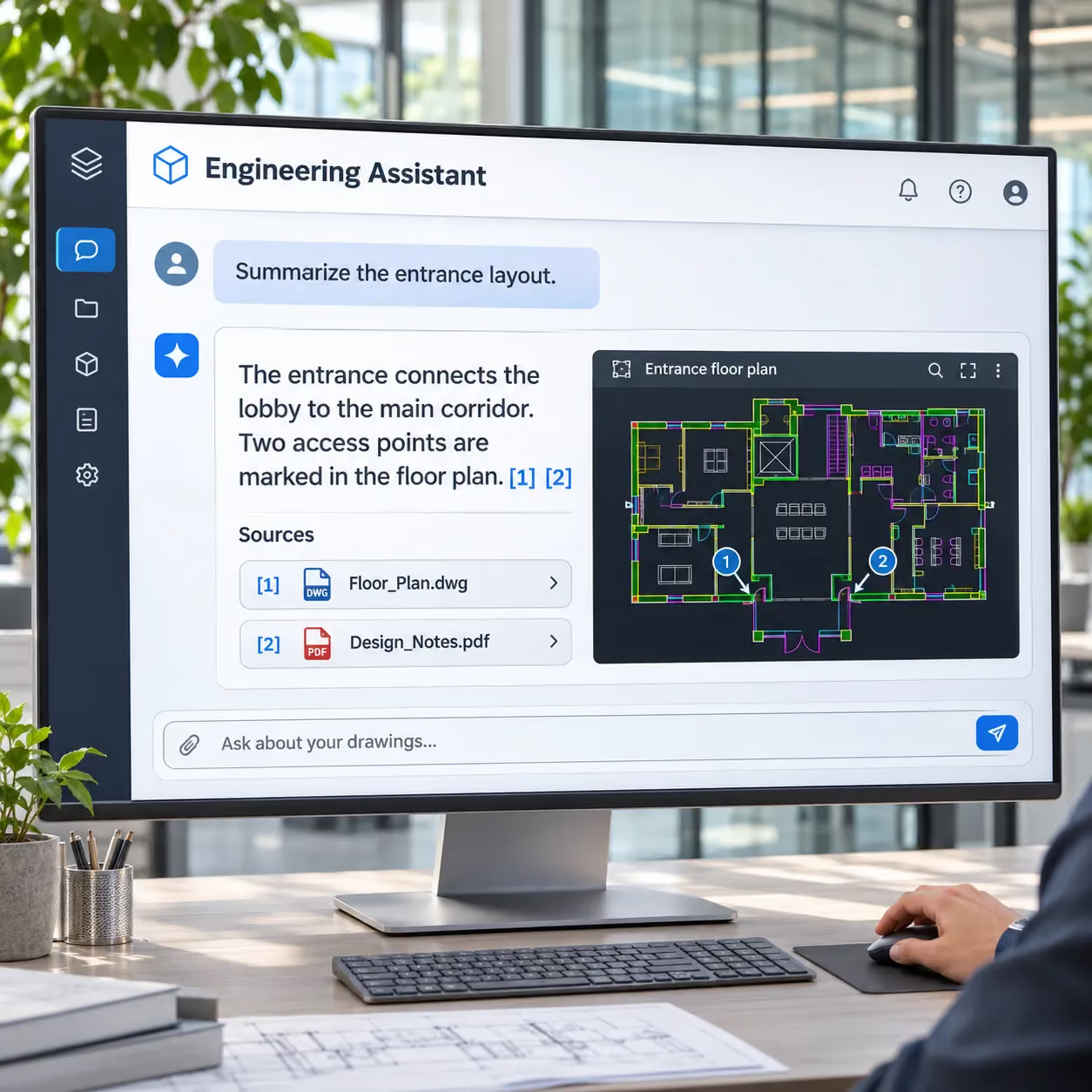
The existing RAG system could retrieve technical text but not the drawings engineers needed to apply its answers.
WhizzBridge’s Solution
WhizzBridge extended the existing RAG architecture with visual retrieval, smarter document processing and improved search.
- Visual retrieval with text: Stored image references within the same knowledge-base passages as their descriptions, keeping drawings connected to their source text.
- Citation-based image delivery: Returned only the supporting visuals from passages cited in the AI's answer, with a limit of five images per response.
- Intelligent processing tiers: Used PyMuPDF to identify technical images and route pages to the appropriate LlamaParse tier, controlling processing costs.
- Context-aware image extraction: Identified the software covered by each document and filtered recurring logos before image processing.
- Resumable document processing: Saved progress page by page so failed runs could continue without repeating completed work.
- Multi-query search: Generated alternative question phrasings, searched them in parallel and merged the results to improve retrieval of relevant engineering content.
Results We Achieved
The redesigned assistant now delivers grounded engineering answers alongside the drawings and diagrams supporting them.
- 95%+ answer accuracy: Improved from approximately 75% on the same held-out test questions.
- Visual evidence with answers: Returns relevant CAD screenshots and diagrams from the passages cited by the AI.
- Up to five images per response: Keeps supporting visuals focused and traceable to their source pages.
- More predictable processing costs: Uses the highest-capability parsing tier selectively, at 45 credits per page.
- Resumable document processing: Saves page-level progress so interrupted runs can continue without reprocessing completed pages.
Engineers can now find both the technical explanation and the visual evidence they need without manually searching through lengthy documentation.
Seeking a Partner? Our expert team is here for you
To get started, we would like to gather more information about your needs. We will evaluate your application and set up a free estimation call


