


.webp)
Investing in Microsoft Dynamics 365 is not just about buying software; it’s about transforming how your organization operates, sells, serves, and scales. In 2026, businesses evaluating MS Dynamics 365 Pricing are looking beyond license fees. They want clarity on the total cost of ownership, ERP vs CRM pricing differences, implementation timelines, and long-term ROI.
Microsoft Dynamics 365 offers modular cloud-based applications across CRM and ERP. The flexibility is powerful, but it also means pricing depends on your configuration, user roles, integration requirements, and business complexity.
This guide breaks down Microsoft Dynamics 365 pricing, dynamics 365 pricing, dynamics erp pricing, and Microsoft Dynamics 365 crm pricing in a structured, practical way for decision-makers in 2026.
Understanding Microsoft Dynamics 365 Pricing in 2026
Microsoft Dynamics 365 operates on a subscription-based model. Organizations pay per user, per month, depending on the applications selected. However, licensing is only one part of the overall cost.
The platform follows a Base and Attach license structure. A user must first purchase a base license (primary app). Additional apps can then be added at a reduced attach price. This model allows businesses to combine Sales, Customer Service, Finance, or Supply Chain without paying full price for every module.
While Microsoft standardizes licensing costs globally, implementation and customization expenses vary depending on the partner and project complexity. Below is a simplified 2026 overview of the pricing structure across CRM and ERP categories.
Microsoft Dynamics 365 Pricing Overview (CRM vs ERP)
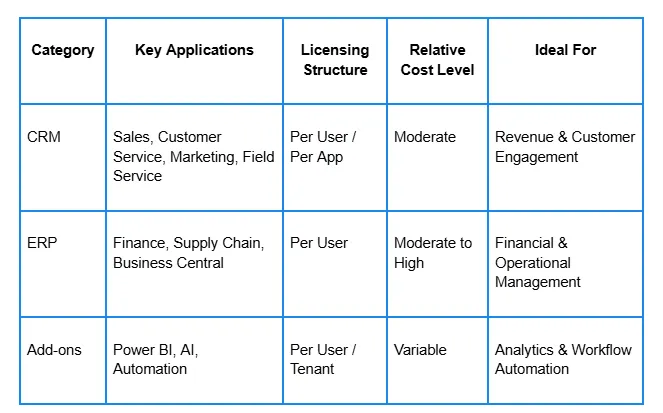
CRM modules generally cost less to implement compared to ERP because they focus on customer engagement rather than core financial architecture. ERP solutions involve deeper configuration of accounting structures, procurement flows, inventory management, and compliance processes.
>> Related Post: Top 3 MS Dynamics 365 Finance & Operations Companies in 2026
Complete Cost Components of Microsoft Dynamics 365
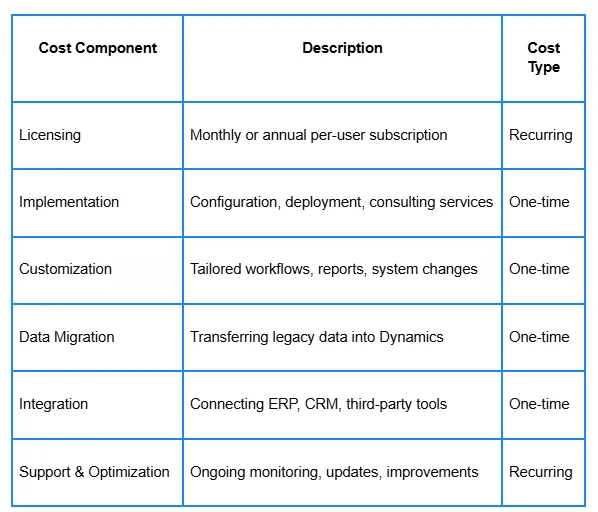
The biggest variables in overall cost are customization and integration complexity. Organizations that require multiple system integrations, such as eCommerce, HR platforms, or advanced analytics, will see higher implementation investments. Similarly, poor data hygiene increases migration time and testing cycles.
What Influences Dynamics 365 Pricing the Most?
Several strategic factors significantly affect total cost.
The first is scope. Implementing Sales alone costs far less than deploying Sales, Customer Service, Marketing, and ERP modules together.
The second factor is process maturity. If your workflows are not clearly defined, additional discovery workshops and reconfiguration may increase costs.
Third is integration depth. Connecting Dynamics 365 to legacy ERP systems or external automation platforms increases development effort.
Fourth is scalability planning. A phased rollout may reduce upfront costs while enabling controlled expansion over time.
>> Related Post: Odoo Pricing: Implementation Cost and Pricing Details [2026]
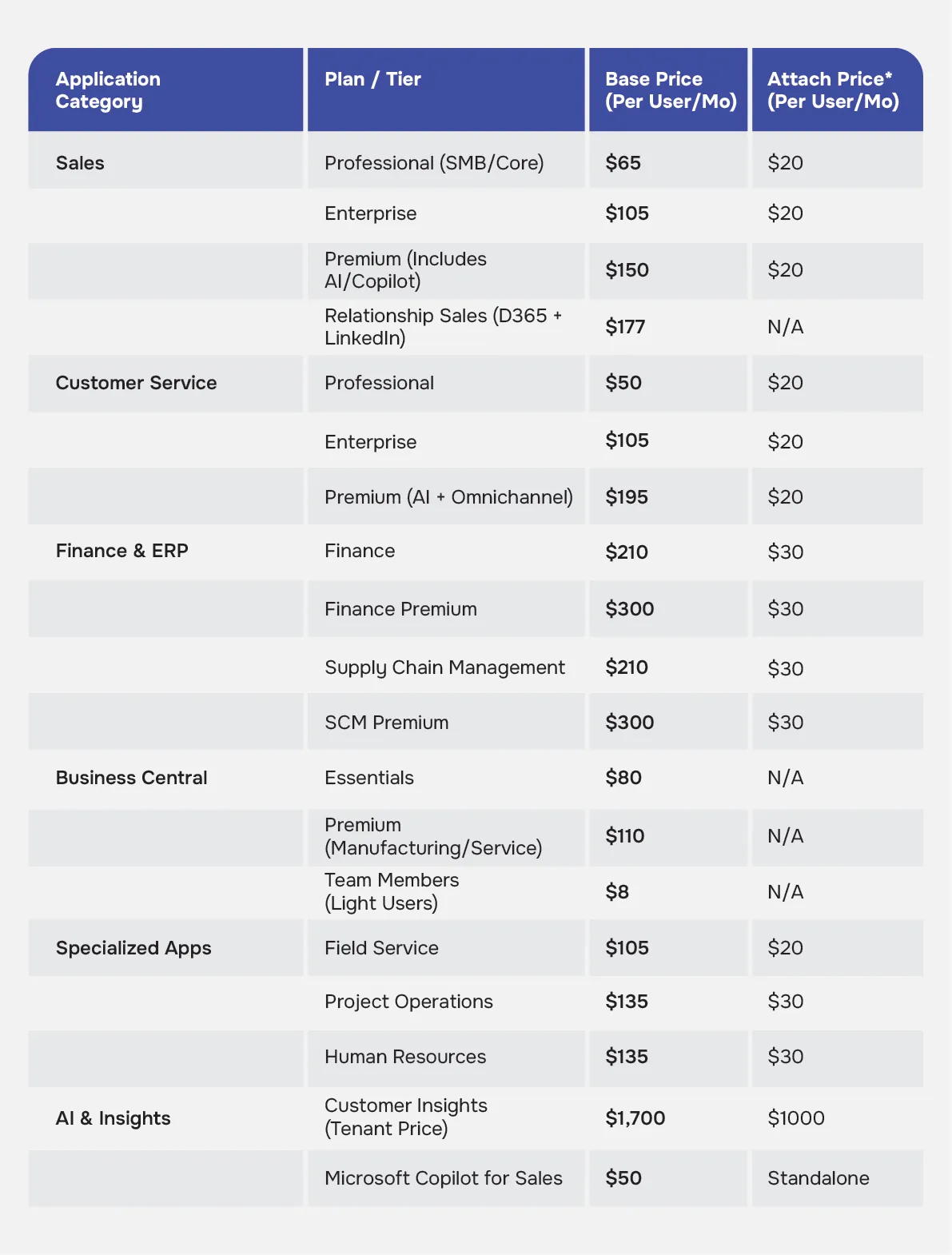
Microsoft Dynamics 365 Pricing in 2026:
Key Takeaways for Your 2026 Strategy
- Copilot Inclusion: If you buy Sales Premium ($150), Microsoft 365 Copilot for Sales is generally included.
- If you are on Sales Enterprise ($105), you have to pay the $50/mo add-on to get the full Copilot experience, making the Premium tier a better value for AI-focused teams.
- The "Attach" Strategy: In 2026, the best way to save money is to buy the most expensive license (like Finance at $210) as your "Base" and then attach others for $20-$30.
- Business Central (BC) vs. F&O: Business Central ($80–$110) remains the best choice for mid-market companies.
- Finance & Operations ($210–$300) is now strictly positioned for large-scale global enterprises with complex regulatory needs.
- Customer Insights: This is now a Tenant-based license (not per user). One $1,700 license covers your whole company for a set amount of data, but if you have 10+ Enterprise seats of other apps, you qualify for the $1,000 attach rate.
Please Note: While we strive to provide the most accurate and up-to-date information for our readers, Microsoft Dynamics 365 pricing is subject to frequent changes based on Microsoft’s global policies, regional currency adjustments, and specific licensing agreements.
Actual costs may vary based on your location, industry discounts (e.g., Non-profit or Education), and your chosen implementation partner’s service fees. Always consult with a certified Microsoft partner for a formal quote tailored to your business needs.
>> Related Post: Top 5 Application Modernization Companies in 2026
MS Dynamics 365 Implementation with WhizzBridge
Choosing the right implementation partner plays a critical role in controlling cost and maximizing ROI. At WhizzBridge, we approach MS Dynamics 365 pricing strategically. Instead of pushing unnecessary licenses, our consulting-first methodology ensures:
- Clear discovery and requirements mapping
- Cost-efficient licensing strategy
- Phased implementation roadmap
- Seamless Azure and Power Platform integration
- AI-driven automation alignment
We help businesses avoid over-licensing while ensuring scalability for future growth. Whether you are evaluating Microsoft Dynamics 365 pricing for CRM optimization or enterprise ERP modernization, our team ensures that your investment aligns with operational efficiency and long-term performance goals. Our approach focuses on measurable ROI, data-driven decision-making, and system optimization beyond go-live.
FAQs
1. What is the average Microsoft Dynamics 365 pricing per user in 2026?
Pricing varies by module and user role, typically structured as per-user subscriptions.
2. How much does implementation cost?
CRM projects may range from structured mid-level investments, while ERP deployments can extend significantly higher depending on complexity.
3. Is CRM cheaper than ERP?
Generally, yes, because ERP systems require deeper financial and operational configuration.
4. What affects dynamics erp pricing the most?
Financial complexity, compliance requirements, and integration scope are major cost drivers.
5. Can Dynamics 365 scale as my business grows?
Yes. Additional users and modules can be added over time.
6. Are there hidden costs?
Unexpected costs usually arise from poor planning, scope expansion, or legacy data cleanup.
7. How long does implementation take?
CRM projects often take a few months; ERP projects may take longer, depending onthe scope.
8. Does Microsoft offer annual discounts?
Annual commitments may provide cost advantages over monthly billing.
9. Is Business Central more affordable than Finance & Supply Chain?
Yes, Business Central is generally positioned for mid-market budgets.
10. How can WhizzBridge help reduce implementation cost?
Through phased deployment, optimized licensing strategy, and efficient integration planning.
.svg)


.svg)
Subscribe To Our Newsletter
Be the first to know about our newest projects, special offers, and upcoming events. Let’s build the future together!


.jpg)
.jpg)
.jpg)